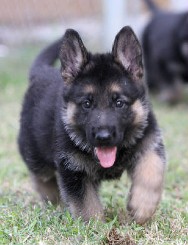
We are showcasing a video sent to us by the owner of one of the puppies from the Nov. 2013 litter. At 10 weeks, this puppy, Bo, responds to many commands: sit, come, down, speak, shake a paw, roll over. This is what you can do with your puppy with a few minutes a day of concentrated training: http://youtu.be/QF5V08hZUjs
Your pup is already registered with AKC. I transfer the ownership of your German shepherd puppy with AKC shortly after it has been picked up, or before it is shipped.
Your purchase price of your puppy covers the cost of this registration and transfer to your name.
I encourage you to choose to pay the extra optional 15.00 extra for AKC's Pet Recovery Program. So that for the lifetime of your ownership of your German shepherd puppy, they will help you to recover your pup. They will keep record of the tattoo number that you call in to them as well as the microchip that you may choose to put in your pup. You must inform them of your microchip number and tattoo number associated with your GSD pup's AKC registration number. Most other sellers of microchips charge an annual fee for the same service.
I hope that you find this section on GSD care helpful.
Please call 252 964-2514 if you have any other questions on German shepherd care, German shepherd health, German shepherd nails trimming, German shepherd fur and brushing, German shepherd hair, grooming a German shepherd, German shepherd diet, German shepherd food, German shepherd puppy food, German shepherd dog food, German shepherd exercise, German shepherd potty training, or how to potty train a German shepherd puppy.
An outstanding German shepherd puppy is built with exceptional care, starting with exceptional prenatal nutrition and care of the dam, as well as nurturing the puppies' love of being petted by stroking gently the mother's swollen belly in the last three weeks of pregnancy.
From birth to the moment when the clients get their pups, we document the detailled care that each pup has received in his own baby book, which is given to each buyer.
Our kennel and each pup's baby book
See a 5 minute visit to part of our kennel that shows you the baby book that we make for each pup.
We have one page for each week the pup is with us. We insert a puppy paw print at the beginning of each week.
We add daily weights, and document all procedures, such as nail trims, worming, vaccinations.
We are proud of the care we give our pups
The book starts with photos of sire and dam, followed by pedigree of sire and dam, titles and achievements of each of their Slovakian ancestors. We end the book with a page detailling the care that your pup should receive, including proposed future vaccination booster dates. Next are the 9 weeks of the pup's life, with milestones described, and notes on each puppy's behavior. We send three videos a week to our clients, starting at 4 weeks of age, to help them choose their pup.
Have fun reading the whimsical "Diary of a German shepherd puppy" from birth to 9 weeks of age, when our German shepherd puppies leave to go to their forever homes. It is ongoing and gives some indication of the daily care and extra attention that our puppies receive, as well as indicating the personalities of each puppy.
An excellent book on training German shepherd puppies and adult dogs is Purely Positive Training, by Sheila Booth. She includes chapters on selecting a puppy, training a puppy, and training for basic commands. It had its fifth printing around 2006 and is available from Amazon. I highly recommend her book. Written for German shepherd owners by a German shepherd trainer.
German shepherd Health & German shepherd diet:
A prerequisite to good GSD care is that your German shepherd will have fresh water available at all times. We have plenty of fresh water available in the grass yard, and in their kennel. I regularly use bleach to disinfect the dishes and eliminate possible giardia organisms, before replacing the water. I daily clean whatever poo is on the grass, to keep their feet clean, and so that they do not get a taste for faeces (poo). The water dishes are cleaned many times a day and new fresh water added. We must clean the dishes many times a day, because German shepherd puppies will step in the water. (Also, water which has stood for overnight will lose its oxygen content, and develop a bacterial “slime,”as well as perhaps cause giardia.) Click this link to learn more about guardia in dogs:www.canismajor.com/dog/giardia.htmlYou will likely only have to clean the water dish once a day.
I feed the German shepherd puppies first thing in the morning; at eight weeks of age, they eat outside, unless it rains, which gives them a chance to immediately take a pee / poo break.Many of them will grab a bite to eat, then run off to pee / poo, then return to eat more.
At nine weeks of age, each German shepherd puppy will eat 3 cups (more or less) of Purina Pro Plan "Large Breed" Puppy, Chicken and Rice . He eats his German shepherd puppy food threetimes a day;this three cups is divided into three meals:first thing in the morning, at lunch time, and after dinner time. The Large Breed Formula has less calcium and reduces the risk of overly accelerated growth that can cause joint issues in German Shepherds.
As they grow, you will feed them more.But, be careful not to overfeed a growing German Shepherd puppy!!!
Most experts think that overfeeding causes too rapid growth (at a time when his epipheses (- growing ends of growing bones -) are not fully developed in the German shepherd pup.) This creates hip/elbow problems even in a young German shepherd dog who was not genetically predisposed to developing a problem.Follow the guidelines on the chart on the back of the bag of German shepherd dog food for the daily amount to feed, as your German shepherd puppy grows. Whatever German shepherd food you choose to feed your puppy, look where the ingredients are listed to ensure that the food has been tested and approved by AAFCO or at least formulated using AAFCO guidelines. Check out
A young German shepherd dog (5 to 18 months) may develop panoestitis (pano) which manifests as temporary soreness in the joints, and is not a precursor to hip dysplasia.Many vets think that it is caused by overfeeding or overexercise. So far, none of my clients have reported an occurance of pano. If you see evidence of this, you should try feeding adult dog food, as opposed to the puppy food, which encourages growth. Click this link to read an excellent article on the topic:http://www.total-german-shepherd.com/Panosteitis-in-the-GSD.html
German shepherd Exercise and German shepherd Potty training:
Also, over exercise or under exercise (& too many stairs) for a German shepherd puppy can also be an impediment to developing the skeletal structure that he is genetically predisposed to have:the old rule of thumb is to have each session of exercise be no more than 5 minutes for each month of his age.For example, a 3 month old puppy, should have each exercise session of no more than 15 minutes, 2-3 times a day.Puppies shouldn’t be going up and down stairs also.
When the weather permits, starting at 5 weeks of age, our German shepherd puppies stay outside under the covered porch, for an hour after eating, to be sure that they have had a chance to pee/poo after their latest eating, drinking. This is done to condition them to habitually doing their business outside, and facilitate German shepherd potty training.
They are brought outside about every 4 hours, or when they actively ask to be let out of their kennel.They seem to know that outside is where they do their business.I walk outside around on the grass, to encourage them all to join on the grass, which seems to stimulate the need to poop; then, praising them, and rubbing their tummy after they do their job. These procedures are recommended as how to potty train a German shepherd puppy.
Teething and the need to chew:
As your German shepherd puppy's teeth develop he will be starting to want to chew on wooden stuff.They are starting to understand a sharp “NO”.I give them nylabones, and hard rubber dental chew toys (dumbells) to satisfy their need to chew, both in their large kennel, and at play time on their bed outside by the door. Dirty rubber toys and nylabones are cleaned in the dishwasher. A rolled up damp facecloth, placed in the freezer, will result in a cold, "chew relief" teether for those growing sore teeth.
I would never give a puppy anything made of rawhide, which can swell after the puppy ingests it and cause a problem.
Note: ALL Puppies go through a period of time when they like to chew on people's hands, ankles, etc. They need to be taught bite inhibition. There are countless articles on the internet on the topic: how do I teach my puppy bite inhibition. Basically, they learn this from their mother and their littermates as well. Do NOT let the situation become a habit. Consistent correction and offering an alternative to bite will virtually eliminate the problem by the time the puppy is 10 - 12 weeks old.
Your German shepherd nails:
The German shepherd fur / German shepherd hair does not require much care other than regular brushing, especially at the turn of the seasons when they may shed more hair. Grooming a German shepherd does not require a lot of time and is rather simple. To prepare our German shepherd puppies for grooming and nail care, I start to do each puppy's nails with a dremel, around 3-4 weeks of age. At this age, the puppy has no fear whatsoever, and quite accepts everything new. The advantage of starting to trim German shepherd puppy nails at this time, is to ensure that the sharp nails do not dig into mommy's teats and cause her to want to avoid nursing the puppies. Also, we are getting them used to having their German shepherd nails done, which will make your care of your German shepherd puppy much easier. We wrap the puppy securely in a large towel or blanket to help keep the pup feel more secure while the nails are being trimmed with the Dremel. We use a Dremel 8000 to trim the nails about once a week, from the third week till they leave our home.
Crate Time:
I wait till the German shepherd puppies are tired (after play time, and after each German shepherd puppy has had his daily 5 - 7 minute train / play session with me) before doing their crate time;then I gently put the sleepy GSD puppy in his own crate, which is covered with an old blanket to create a “cave” feeling, and hide distractions.The crate is an excellent tool to help with potty training.Most puppies will not relieve themselves in a crate, providing he is not in a crate that is too large for him. Remember your crate will need to be 30 inches high to accommodate the puppy when full grown;there are crates available with a wire divider that will allow the crate to “grow” as the puppy grows.Many GSD dogs like to sleep in their crates, even as adults.Also, having a crate big enough for your German shepherd dog as an adult may be necessary if you take him on a long car ride, or he is ill, or you need to contain him for some other reason, such as if you have a number of visiting guests.
The stress of all the excitement and newness of everything, can cause loose stools or diarrhoea:
Going for a long car ride, then a new home and the excitement of all that happens can stress out a puppy.If the puppy gets mild diarrhea (loose stools but not watery), it may likely be a result of all the stresses of the last few hours or the change from the type of water he was used to.An old fashioned remedy for diarrhoea is to give him a little canned pumpkin instead of his meal. If this does not clear up his diarrhea or it gets more watery, call your vet. Three days in a row of soft pudding poop may indicate coccidia or giardia lambia.. see your vet.
If the GSD puppy ever gets really watery poo, take him to a vet as soon as possible.If the German shepherd puppy gets watery poo mixed with blood, you have a medical emergency.Take him to the vet immediately.I never give a puppy anything made of rawhide; it swells after the puppy ingests it and may cause a problem.
There is a single celled parasitic organism that is naturally found in soil, no matter how clean you keep your area.It is more prevalent in the southern states (where the soil does not freeze deeply to kill off organisms).It can be detected by the vet by microspopic examination of faeces.Coccidia cells are immune to wormings.It is also transmitted by mice, squirrels, other rodents and even insects. Coccidia can cause serious damage to a young puppy's G.I. system. Read a good article about coccidia at this website:http://www.marvistavet.com/html/body_coccidia.html.A sign that your puppy may be infected is watery stools.Your vet will likely prescribe "Albon" and / or an antibiotic to treat the problem. After six months of age, German shepherd dogs usually develop an immunity to it.
German shepherd puppy Wormer and German shepherd puppy Vaccination details
Vaccination:Duramune Max (intended for puppies) is given on at 6 weeks, to protect against Distemper, Adenovirus Type 2, Parainfluenza, Parovirus Type 2b.
Your German shepherd puppy is due for two more vaccinations at 3-4 week intervals after the first vaccine.(2nd vaccine due at 9-10 weeks of age.Vaccinate at 3-4 week intervals till 16 weeks of age. You will be given the labels from the vials that were used for his vaccinations at our home, to show your veterinarian. Your vet will like to know the "Lot number" of the vaccine that was used on your German shepherd puppy in case of a vaccine recall. In addition to the labels from the vials being posted on your 5 weeks of daily notes; we record notes on weight gain each week, nail trimming, vaccinations, worming and temperament observations. Save the 5 weeks notes which have the labels from the vaccinations given; show them to your vet.In case of a recall of any vaccine, it is helpful for him to know the Lot number of the vaccine that your German shepherd puppy was given. Your local veterinarian is expert in the vaccines that are most necessary for growing puppies in your area. It is he whose advice you should follow!
Wormer: We give liquid pyrantel pamoate to the 2 week old German shepherd puppies. Puppies are wormed at 2 weeks, 4 weeks, 6 weeks and 8weeks. At 10 weeks of age, we recommend the chewable form of Worm-X Plus, which has the pyrantel pamoate with praziquantel added for tapeworms. See inside your notes that you will get with your German shepherd puppy for details of wormer used.Ideally worm at 10 weeks and 12 weeks, then worm once a month, thereafter, or as your vet instructs. Again, your vet knows what parasites are common to your area; take his advice.
Heartworm medicine for puppies is only available at the vet.They will give it as early as 9 weeks (some vets start it later), usually monthly after that. Your vet will also need to give him his first rabies shot; this varies according to the schedule that he/she prefers, usually the rabies shot is given at 3 months.
CHOICE OF A MALE OR A FEMALE?
I personally think that females make better family pets than males. They will not develop the need to "mark" their territory when the testosterone starts to flow. Females tend to be more protective of the home.
I am asked about neutering males and spaying females all the time. Thus, I felt it was a good idea to give some insight into the issue.
Potential for problem with the intact female:
Read up on pyometra, and canine cystic endometrial hypoplasia. and canine endometritis, possible in the unspayed female canine. The following is a simplification of a complex issue: One of the major difference between human females (who should not breed back to back) and canines, is that each month, the human female sheds the lining of her uterus, totally. So the lining of the uterus always stays relatively fresh, and a new lining is waiting at the moment of conception for the implantation of the egg. Without a successful pregnancy, the canine bicornate uterus NEVER has its lining totally shed. In fact, the opposite is true. Each time an intact (unspayed) female has a heat cycle without breeding, the lining of the uterus gets a bit more thickened. The more heats without a pregnancy, the more it thickens. This thickening increases to cystitis, and can lead to pyometra (an infection in the uterus, which can be life threatening). Most "normal" intact (unspayed) female canines have a heat cycle, approximately 6 months apart. It is also normal for the heat cycles to be slightly more or less frequent, as in every 5 to 7 months. However, those who have shorter cycles, will have more heat cycles in a two year period; this will increase the rate of thickening of the lining of the uterus. Some vets recommend that those females who short cycle are good candidates for some back to back breedings. Of course there are many who feel that the female of the sex is often more laid back and more protective of the home. She certainly will not wander off to make a "nature call" when she smells the scent of another female in heat. Here is an excellent article which suggests the advantages and disadvantages of neutering / spaying your pets http://healthypets.mercola.com/sites/healthypets/archive/2011/02/17/dangers-of-early-pet-spaying-or-neutering.aspx. I certainly agree that there are obvious disadvantages to early neutering and spaying which deprives the growing dog of necessary hormones to optimize their growth.
Also, latest research shows that if you are going to neuter your German shepherd puppy, 6 months is the optimum time to do it (before) their hormones start to kick in.
Feel free to call me with any questions, concerns or if I can help in any way.252-964-2514
I continue to support my puppy buyers long after the puppies have left my home. I care about the well being of my "babies". I do ask that if something happens that you cannot keep your puppy / dog, please contact me first, before finding his new home.
I keep a slideshow for your puppy on my website, for you to keep a record of his progress.I appreciate emails telling me of the puppy’s progress, and photos of the puppy’s growth.
Checklist – Did I Give You:
AKC unlimited registration will be filled in, and paid for by me. I will give you theAKC Litter certificate. You will be mailed the AKC “New Puppy” brochure by AKC when you get your registration papers,
Sales Agreement and Contract, signed by both of us.
Daily notes on your puppy, his play time and his training sessions from 4 weeks to 8 weeks of age.
Vaccination labels and wormer information & your puppy’s new toy.
This is a sample of the page that is found as the last page of your puppy's baby book:
Important Dates and Puppy Care
The 25.00 microchip fee includes a 15.00 lifetime pet recovery service from AKC. Register the microchip and tattoo number online at www.akcreunite.com. Call 800 252-7894 to tell them if your baby gets lost.
They were given another worming May 14, 2015 with a measured dose of liquid Pyrantel Pamoate, appropriate for pup’s weight, given with a syringe to give a perfect dose.
Their second vaccine booster is due at 9 weeks, May 24
Your pup is due for the third vaccine booster around June 14, or as your vet recommends. You can get Spectra 5 way from Tractor Supply and give it just under the fold of skin between the shoulder blades, or have your vet do it. I am sure that you can find videos on YouTube on how to do it. It is quite easy.
Your vet will want to give the first rabies booster around 12 weeks, or a little later, no sooner than June 15, 2015.
Your pup has had nails regularly done using a Dremel. Using clippers puts pressure on the quick adjacent to the cut, and over time, your dog will be increasingly more resistant to having nails done if you use the clippers; however, over time, pup will realize the dremel trimming is not painful and will be increasingly less resistant. I wrap the pups in a big towel or small blanket, and my husband holds them while I take out each paw and do the nails.
Your baby eats between 2 ½ and 3 cups of Purina Pro Plan Large Breed Puppy (Focus) puppy food daily. They eat first thing in the morning, between noon and 1 pm then again between 7 and 8 pm. They always need to poop within 15 minutes of eating. I get the food from www.chewy.com. No sales tax, free delivery, and they always have it.
I buy the economy 34 pound bags. When I am only feeding puppy food to pregnant females, I put the food in gallon sized zip lock bags, and put them in the freezer till needed. Each bag holds about 16 cups of food. The vitamins in the food can deteriorate if left for a long time at room temp.
It is critical that you not overfeed a large breed dog for the first year. Overfeeding, and feeding puppy mix meant for small breeds can cause accelerated growth which can cause the joints to develop too quickly, which can cause joint issues.
Remember, for the sake of their growing joints, avoid letting them leap from stairs or and heights.
Also, keep them from disease prone places, dog park, Pet Smart, till they have finished their vaccinations, and the vet says it is safe to let them near these places.
Your pup may experience a bit of loose stools with the stress of new home, new people, new everything You can mix a little pumpkin in with the food, or give 1/4 cup of yogurt (to boost his probiotics), or 5 ml of pepto bismal per 10 pounds of weight, or call us 252 964-2514.
These pups do try to go potty on the paper. Using a crate will make potty training at your home so much easier!
They have been outside. Mostly in their safe puppy area. I have let them experience grassy area under supervision.
The green on their ear tattoo will fade soon. Don’t wash it, or you may leach out the ink from their tattoo.
The last page of the puppy book has good recommendations for worming and worming products. Avoid Heartguard, which does not have Praziquantel in it, which kills tapeworms. Ivermectin and pyrantel pamoate do not kill tapeworms.
I look forward to adding a photo of your “baby” when he or she is between 10 months and a year or so to my baby book. Send photos to vomweiland@hotmail.com. Enjoy your baby
Important Dates and Puppy Care
The 25.00 microchip fee includes a 15.00 lifetime pet recovery service from AKC. Register the microchip and tattoo number online at www.akcreunite.com. Call 800 252-7894 to tell them if your baby gets lost.
They were given another worming May 14, 2015 with a measured dose of liquid Pyrantel Pamoate, appropriate for pup’s weight, given with a syringe to give a perfect dose.
Their second vaccine booster is due at 9 weeks, May 24
Your pup is due for the third vaccine booster around June 14, or as your vet recommends. You can get Spectra 5 way from Tractor Supply and give it just under the fold of skin between the shoulder blades, or have your vet do it. I am sure that you can find videos on YouTube on how to do it. It is quite easy.
Your vet will want to give the first rabies booster around 12 weeks, or a little later, no sooner than June 15, 2015.
Your pup has had nails regularly done using a Dremel. Using clippers puts pressure on the quick adjacent to the cut, and over time, your dog will be increasingly more resistant to having nails done if you use the clippers; however, over time, pup will realize the dremel trimming is not painful and will be increasingly less resistant. I wrap the pups in a big towel or small blanket, and my husband holds them while I take out each paw and do the nails.
Your baby eats between 2 ½ and 3 cups of Purina Pro Plan Large Breed Puppy (Focus) puppy food daily. They eat first thing in the morning, between noon and 1 pm then again between 7 and 8 pm. They always need to poop within 15 minutes of eating. I get the food from www.chewy.com. No sales tax, free delivery, and they always have it.
I buy the economy 34 pound bags. When I am only feeding puppy food to pregnant females, I put the food in gallon sized zip lock bags, and put them in the freezer till needed. Each bag holds about 16 cups of food. The vitamins in the food can deteriorate if left for a long time at room temp.
It is critical that you not overfeed a large breed dog for the first year. Overfeeding, and feeding puppy mix meant for small breeds can cause accelerated growth which can cause the joints to develop too quickly, which can cause joint issues.
Remember, for the sake of their growing joints, avoid letting them leap from stairs or and heights.
Also, keep them from disease prone places, dog park, Pet Smart, till they have finished their vaccinations, and the vet says it is safe to let them near these places.
Your pup may experience a bit of loose stools with the stress of new home, new people, new everything You can mix a little pumpkin in with the food, or give 1/4 cup of yogurt (to boost his probiotics), or 5 ml of pepto bismal per 10 pounds of weight, or call us 252 964-2514.
These pups do try to go potty on the paper. Using a crate will make potty training at your home so much easier!
They have been outside. Mostly in their safe puppy area. I have let them experience grassy area under supervision.
The green on their ear tattoo will fade soon. Don’t wash it, or you may leach out the ink from their tattoo.
The second to last page of the puppy book has good recommendations for worming and worming products. Avoid Heartguard, which does not have Praziquantel in it, which kills tapeworms. Ivermectin and pyrantel pamoate do not kill tapeworms.
I look forward to adding a photo of your “baby” when he or she is between 10 months and a year or so to my baby book. Send photos to vomweiland@hotmail.com. Enjoy your baby